Professional Abrasives & Grinding Solutions +8615890168176 xlabrasivematerial@gmail.com

Applications of Abrasive Materials in the Automotive Industry
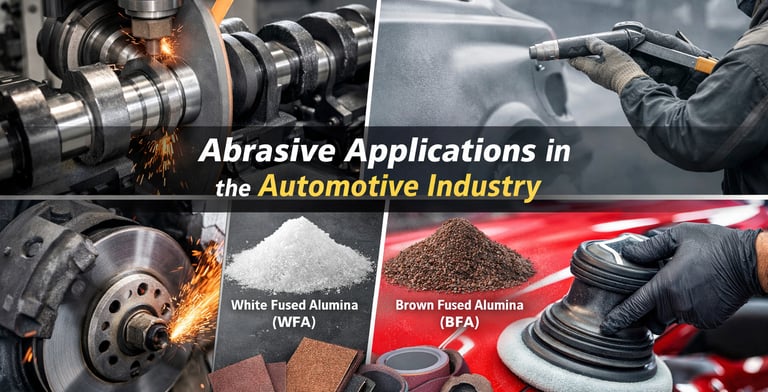
Abrasive materials play a crucial role in the automotive industry, supporting everything from raw material processing to final surface finishing. White fused alumina (WFA) and brown fused alumina (BFA) are among the most widely used abrasives due to their excellent hardness, durability, and versatility. This article explores how these materials are applied across different stages of automotive manufacturing and maintenance.
NEWS&BLOG
4/23/20262 min read
1. Introduction
The automotive industry demands high precision, durability, and surface quality. Abrasive materials are essential tools that enable manufacturers to shape, refine, and finish components efficiently. From engine parts to exterior coatings, abrasives are involved in nearly every production step.
White fused alumina and brown fused alumina are particularly valued for their performance in both precision and heavy-duty applications.
2. Engine Component Manufacturing
2.1 Precision Grinding of Engine Parts
Automotive engines require extremely tight tolerances and smooth surface finishes. Abrasives are used in grinding processes for components such as:
Crankshafts
Camshafts
Pistons
Cylinder heads
White fused alumina is commonly used in these applications due to its high purity and sharp cutting edges, which produce fine finishes and reduce the risk of contamination.
2.2 Surface Finishing and Polishing
To ensure optimal performance and reduce friction, engine parts often undergo polishing processes. WFA micro-powders are used to achieve:
Low surface roughness
Improved wear resistance
Enhanced mechanical efficiency
3. Body Manufacturing and Surface Treatment
3.1 Metal Grinding and Weld Removal
During car body production, metal sheets and welded joints must be processed and smoothed.
Brown fused alumina is widely used for:
Weld seam removal
Edge grinding
Surface leveling
Its high toughness allows it to withstand heavy pressure and continuous use.
3.2 Sandblasting and Surface Preparation
Before painting, automotive surfaces must be properly prepared. Abrasives are used for:
Removing rust and scale
Cleaning metal surfaces
Creating surface profiles for better coating adhesion
Brown fused alumina is ideal for sandblasting due to its durability and cost efficiency.
4. Automotive Coating and Painting
4.1 Pre-Coating Preparation
Abrasives ensure that surfaces are clean and roughened to improve coating adhesion. Proper preparation directly impacts paint durability and corrosion resistance.
4.2 Post-Paint Polishing
After painting, fine abrasives (often WFA-based) are used to:
Remove surface defects
Improve gloss and smoothness
Achieve a mirror-like finish
This step is especially important in high-end automotive manufacturing.
5. Brake Systems and Safety Components
Abrasives are also used in the production of critical safety components:
Brake discs and pads require precision grinding
Surface texture affects braking performance
Both WFA and BFA are used depending on the required balance between surface finish and durability.
6. Automotive Maintenance and Repair
In aftermarket and repair applications, abrasives are widely used for:
Paint removal
Rust cleaning
Surface refinishing
Scratch repair
Sandpapers and grinding wheels made from fused alumina are standard tools in automotive workshops.
7. Why WFA and BFA Are Preferred in Automotive Applications
White Fused Alumina (WFA)
High purity and low contamination
Sharp grains for precision finishing
Ideal for polishing and fine grinding
Brown Fused Alumina (BFA)
High toughness and durability
Suitable for heavy grinding and blasting
More cost-effective for large-scale use
Conclusion
Abrasive materials are indispensable in the automotive industry, supporting every stage from manufacturing to maintenance. White fused alumina and brown fused alumina offer complementary advantages, enabling both precision finishing and heavy-duty processing. By selecting the right abrasive, manufacturers can enhance product quality, improve efficiency, and reduce production costs.
Abrasives
High-purity abrasives for various industrial applications.
CONTACT US
© 2026. All rights reserved.

