Professional Abrasives & Grinding Solutions +8615890168176 xlabrasivematerial@gmail.com

Grinding Tungsten Carbide with Green Silicon Carbide
Eliminate micro-cracking and thermal damage when grinding or lapping tungsten carbide tools. Learn how to choose the right Green SiC grain sizes optimize your parameters.
6/18/20264 min read
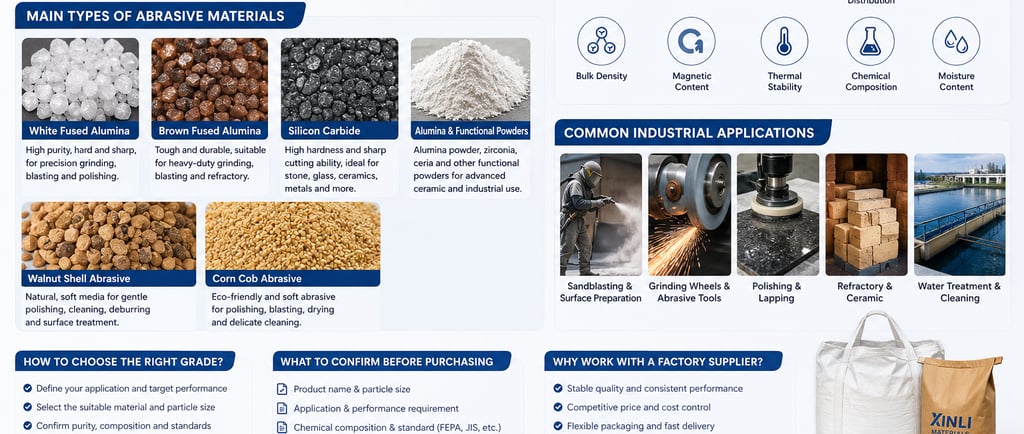
Optimizing Tungsten Carbide Grinding Lapping with Green Silicon Carbide
When it comes to machining, sharpening, or lapping ultra-hard materials like tungsten carbide (cemented carbide), standard aluminum oxide abrasives simply fail. Tungsten carbide demands an abrasive that is harder than the substrate itself, yet capable of cutting cool to prevent thermal stress.
This is exactly where green silicon carbide grain becomes indispensable. Boasting a Mohs hardness of 9.5 (surpassed almost exclusively by diamond), its sharp, highly friable crystals break down under load to constantly expose fresh cutting edges.
However, mismatching your grit size or running a green wheel dry can permanently ruin an expensive carbide tool by inducing micro-cracks or localized burning. This guide simplifies how to choose the right green silicon carbide specifications, how to apply them, and how to troubleshoot common shop-floor issues.
1. Matching the Grain to the Geometry
Unlike softer metals where a single coarse wheel does it all, tungsten carbide must be processed in strictly defined stages to prevent brittle structural fracturing. Green silicon carbide is classified under FEPA standards for either grinding wheels (F-series) or lapping micro-powders (JIS/FEPA micro-grits).
Coarse & Medium Grits: F46 to F90 (Stock Removal & Shaping)
Primary Use: Rough grinding of chipped carbide tool tips, reshaping brazed carbide lathe tools, and heavy stock removal on hard-faced coatings.
Why it matters: These sizes cut fast and deep. However, they leave a rough surface profile and should never be used for final edge sharpening, as they will cause macroscopic chipping along the cutting edge.
Fine Grits: F100 to F220 (Edge Sharpening & Pre-Polishing)
Primary Use: Final sharpening of tungsten carbide end mills, drills, and reamers; initial lapping of mechanical valve seals.
Why it matters: This is the industry sweet spot. It provides a highly uniform matte finish while producing sharp, burr-free cutting edges without generating excessive structural heat.
Micro-Powders
Primary Use: Free-abrasive lapping slurries for carbide seals, hydraulic valves, and draw dies requiring a mirror or sub-micron finish.
Why it matters: These micro-grains remove miniscule amounts of material smoothly, closing up micro-voids to ensure gas-tight or liquid-tight seals.
3. Step-by-Step Shop Floor Best Practices
Carbide is incredibly dense but highly brittle. To get the longest life out of both your green silicon carbide media and your tools, implement these operational rules:
Step 1: Manage Your Thermal Profile (Always Cool If Possible)
Green silicon carbide is highly friable, meaning it self-sharpens as it fractures. However, if pushed too hard against tungsten carbide without lubrication, temperatures at the contact point can spike dramatically.
The Right Way: Use a continuous stream of water-soluble coolant or cutting oil. If you must grind dry (chairside or field repairs), use an ultra-light pass with a very low feed rate and allow the tool to air-cool frequently. Never quench a hot carbide tip in cold water, as the thermal shock will instantly crack the tool chip.
Step 2: Dressing Green SiC Grinding Wheels
Because green breaks down rapidly to remain sharp, vitrified wheels can occasionally "load up" or lose their true geometry over time.
The Action: Regularly dress the green wheel using a diamond dresser tool to restore flatness and expose fresh, aggressive green grains. A glazed wheel creates friction instead of cutting, which spells doom for carbide.
Step 3: Slurry Consistency in Lapping
When using green silicon carbide micro-powders for valve lapping, consistency is key.
The Action: Mix the micro-powder with your carrier oil or water-soluble fluid in a 1:3 or 1:4 ratio by weight. Too much powder causes the grains to crowd and scratch the substrate ; too little powder results in slow, inefficient lapping.
4. Troubleshooting Common Carbide Defects
Problem: "After sharpening our carbide-tipped saws on the green wheel, micro-cracks appear along the teeth under a magnifying glass."
Root Cause: Excessive grinding pressure or grinding completely dry. The intense heat causes differential thermal expansion between the cobalt binder and the tungsten crystals, fracturing the matrix.
Solution: Drop your depth of cut per pass, ease up on manual pressure, and introduce a flood coolant line. Ensure your wheel is dressed and not glazed.
Problem: "We are lapping carbide valve plates, but the surface keeps showing deep random scratches instead of a uniform matte finish."
Root Cause: A contaminated abrasive supply. If even a few stray oversized grains (e.g., F120 grains mixed into an F600 powder batch) enter the slurry, they will act as deep plows.
Solution: Ensure your supplier utilizes dual-stage air classification for micro-powders to guarantee an exceptionally tight Particle Size Distribution (PSD) with absolutely zero large-grit contamination.
5.Conventional aluminum oxide abrasives often prove inadequate for the machining, sharpening, or grinding of super-hard materials such as tungsten carbide (cemented carbide). Processing tungsten carbide requires an abrasive that is harder than the substrate material itself and possesses excellent cool-cutting properties to prevent the buildup of thermal stress. As a specialized manufacturer of synthetic minerals with decades of industry experience, Zhengzhou Xinli Wear-Resistant Materials Co., Ltd. (Xinli Abrasives) provides professional technical expertise for the processing of these super-hard materials.
Summary
Processing tungsten carbide effectively requires a careful balance of raw abrasive hardness and operational control. By choosing high-purity green silicon carbide grain, machinists gain the cutting speed and cool-running performance necessary to maintain tool geometry without inducing catastrophic micro-cracking. Keep your parameters cool, select your grits progressively from roughing to micro-lapping, and always safeguard your slurry against contamination.
FAQ
Q1: What makes green silicon carbide fundamentally different from black silicon carbide?
Q2: Why does our tungsten carbide tools develop micro-cracks along the cutting edge during sharpening on a green wheel?
Q3: We are getting random, deep scratches while lapping carbide valve seals with green micro-powder. How do we fix this?
Q4: Why is our green silicon carbide lapping slurry losing its cutting speed so quickly?
Abrasives
High-purity abrasives for various industrial applications.
© 2026. All rights reserved.

